

How to Validate a Startup Idea Without Spending Money ?
Validate a Startup Idea
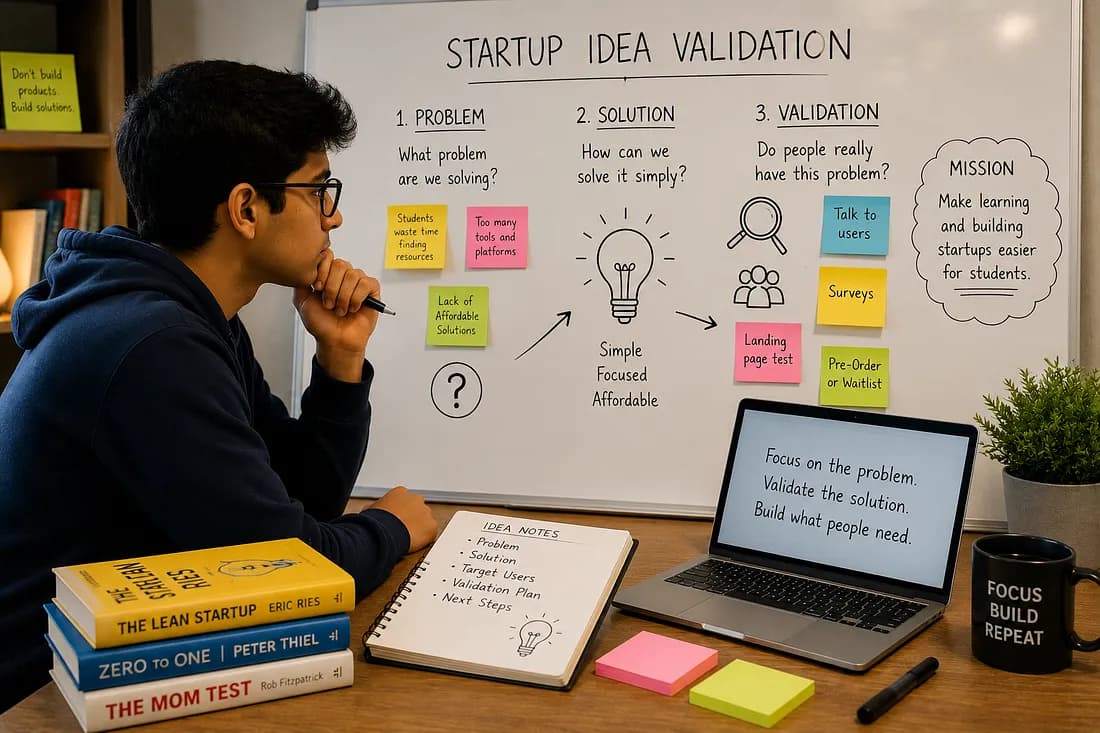
Before you spend months building a product, make sure people actually want it.
One of the biggest mistakes new founders make is building first and validating later.
The process usually looks like this:
1. Get a startup idea.
2. Get excited.
3. Spend weeks or months building.
4. Launch.
5. Realize nobody wants it.
The painful part is that this mistake is completely avoidable.
Validation simply means finding out whether a real problem exists and whether people are interested in your solution before investing significant time and money.
The good news is that you don’t need funding, investors, or expensive tools to validate an idea.
You can do it for free.
STEP 1: CLEARLY DEFINE THE PROBLEM
Most founders start with a solution.
Successful founders start with a problem.
Instead of saying:
“I want to build an AI app.”
Ask:
“What problem does this AI app solve?”
The more specific the problem, the easier validation becomes.
For example:
Bad:
Students need help.
Better:
Engineering students struggle to organize notes across multiple subjects.
The clearer the problem, the easier it is to find potential users.
STEP 2: IDENTIFY YOUR TARGET AUDIENCE
Not everyone is your customer.
Trying to serve everyone usually means serving no one.
Define exactly who experiences the problem.
Ask yourself:
• How old are they?
• What do they do?
• What are their goals?
• What frustrates them?
Example:
Instead of:
Students
Use:
First and second-year engineering students who struggle with time management and assignment tracking.
Specific audiences provide better feedback.
STEP 3: TALK TO REAL PEOPLE
This is where most founders fail.
They ask friends if the idea is good.
Friends usually say:
“That’s a great idea.”
That feedback is almost useless.
Instead, talk to people who actually face the problem.
Ask questions like:
• How do you currently solve this problem?
• What frustrates you most?
• How often does this happen?
• What solutions have you tried?
Avoid asking:
“Would you use my product?”
People often say yes even when they have no intention of using it.
Focus on understanding their behavior instead of seeking approval.
Building without talking to users is one of the biggest reasons startups fail. That’s why customer discovery should always come before development.
Why do most startups fail ?(In my another article i explain it in brief)
STEP 4: LOOK FOR EXISTING SOLUTIONS
Many founders avoid ideas that already have competitors.
That’s a mistake.
Competition often means there is demand.
Research:
• Apps
• Websites
• Businesses
• Products
that already solve the problem.
Ask:
• What do users like?
• What do users complain about?
• What features are missing?
Reviews on Google Play Store, App Store, Reddit, and forums are gold mines of information.
People openly share frustrations there.
STEP 5: CREATE A SIMPLE LANDING PAGE
Before building a product, create a page explaining:
• The problem
• Your solution
• The benefits
Include a button like:
“Join the Waitlist”
or
“Get Early Access”
You can create a landing page for free using:
• Notion
• Canva
• Google Sites
• Carrd
The goal isn’t to sell.
The goal is to measure interest.
If nobody signs up, that’s important information.
If people do sign up, you may be solving a real problem.
You don’t need expensive tools to test an idea. Platforms like Carrd, Notion, and Canva make it possible to create a professional landing page in less than an hour.
You can check out carrd here :- https://try.carrd.co/yvb61c84
STEP 6: USE SOCIAL MEDIA AS A VALIDATION TOOL
Social media provides free market research.
Post questions on:
• LinkedIn
• Reddit
• X (Twitter)
• Facebook Groups
• Discord Communities
Examples:
“What’s your biggest challenge as a student founder?”
or
“What productivity tool do you wish existed?”
The responses can reveal patterns you never considered.
People often tell you exactly what they need.
You just have to listen.
STEP 7: BUILD A MINIMUM VERSION
Don’t build the full product.
Build the smallest version possible.
Ask yourself:
“What’s the simplest way to solve the problem?”
Many startups waste months creating features nobody uses.
A basic solution allows you to learn faster.
Remember:
Validation comes before optimization.
STEP 8: TEST DEMAND BEFORE BUILDING
One of the best validation methods is seeing whether people are willing to take action.
Actions matter more than opinions.
Examples:
• Joining a waitlist
• Booking a demo
• Sharing contact information
• Referring friends
• Pre-ordering
If people won’t take small actions, they probably won’t become customers later.
STEP 9: PAY ATTENTION TO REPEATED COMPLAINTS
During validation, patterns matter.
If multiple people complain about the same issue, pay attention.
For example:
If ten students mention difficulty organizing notes, that’s stronger evidence than one person mentioning it.
Look for recurring problems.
Recurring problems often indicate business opportunities.
STEP 10: KNOW WHEN TO PIVOT
Sometimes validation reveals that your original idea isn’t strong.
That’s okay.
Validation is not about proving you’re right.
It’s about discovering the truth.
A small adjustment can sometimes transform a weak idea into a strong one.
Successful founders are willing to adapt.
COMMON VALIDATION MISTAKES
Avoid these mistakes:
• Building too early.
• Asking leading questions.
• Ignoring negative feedback.
• Talking only to friends.
• Falling in love with the idea.
Stay attached to the problem, not the solution.
FINAL THOUGHTS
Validating a startup idea doesn’t require money.
It requires curiosity.
Before building anything:
• Understand the problem.
• Talk to users.
• Study competitors.
• Test demand.
• Look for patterns.
The goal of validation isn’t to prove your idea is amazing.
The goal is to discover whether people genuinely need what you’re planning to build.
Because the cheapest mistake in business is changing an idea before you build it.
The most expensive mistake is discovering nobody wants it after you’ve already built it.
…………….. Thank You for Reading………………….
Related Articles
Subscribe to our newsletter
Weekly insights on startups, business, and technology — right in your inbox.