

Google Gemini AI: The Complete Guide to Google's Multimodal AI Platform
An in-depth exploration of Gemini, Google's most capable AI model, and how it's reshaping AI capabilities across applications.
## Introduction
Google has always positioned itself at the forefront of artificial intelligence research and development. From DeepMind's breakthroughs in game-playing AI to cutting-edge language models, Google's influence in the AI space has been undeniable.
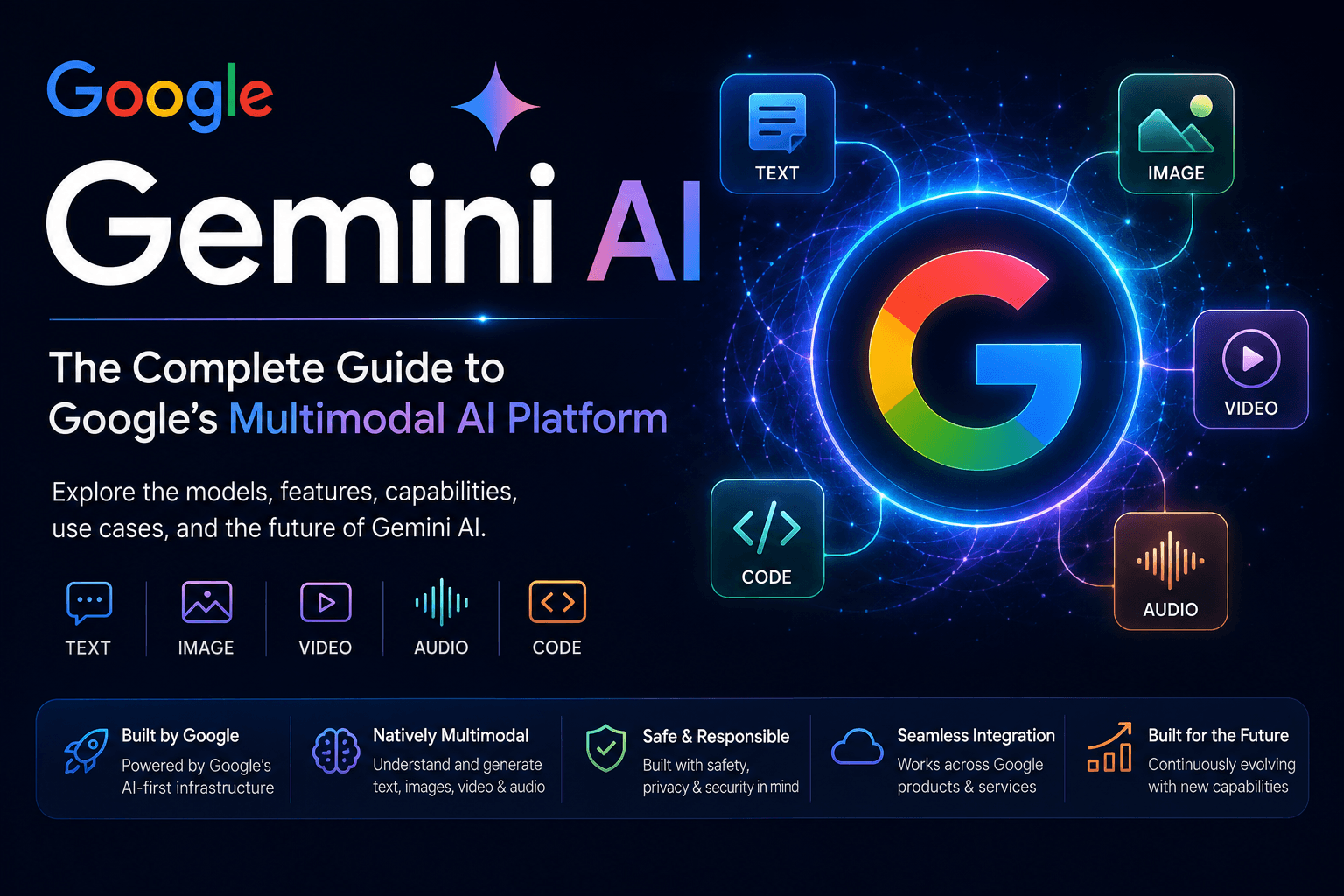
Gemini represents Google's answer to the rapid advancement in generative AI. Launched in late 2023 and continuously evolved, Gemini is positioned as Google's most capable AI model yet—a multimodal powerhouse that can process text, images, video, and audio.
This comprehensive guide explores what makes Gemini unique, how to leverage its capabilities, and why it matters for businesses, developers, and individual users looking to harness cutting-edge AI technology.
---
## What is Google Gemini?
### The Foundation
Gemini is Google's latest generation of large language models (LLMs) built on a transformer-based architecture. Unlike earlier Google models that often processed modalities sequentially, Gemini was built from the ground up as a natively multimodal model—meaning it understands and generates text, images, video, and audio simultaneously.
### Key Characteristics
Google-Scale Infrastructure: Built on Google's TPU (Tensor Processing Unit) infrastructure, Gemini benefits from decades of Google's machine learning research and infrastructure investments.
Natively Multimodal: Unlike models that bolt on image/video understanding, Gemini processes multiple modalities as a unified system, enabling more sophisticated reasoning across different input types.
Optimized Variants: Google offers multiple versions of Gemini optimized for different use cases—from lightweight models for mobile to ultra-powerful variants for complex tasks.
Integration with Google Services: Seamless integration with Google's ecosystem (Gmail, Docs, Sheets, Search, Workspace, Cloud services) creates unique opportunities for automation and productivity.
Constitutional AI Principles: Trained with safety considerations, Gemini includes built-in safeguards against misuse while remaining capable and helpful.
### Google's AI Philosophy
Gemini reflects Google's approach:
- Responsible AI: Safety and ethics are core considerations
- Open Accessibility: Making AI available to everyone, not just enterprises
- Real-World Impact: Focus on practical applications that solve actual problems
- Continuous Improvement: Regular updates and new capabilities
---
## Gemini Model Variants
Google offers several versions of Gemini, each optimized for different needs:
### Gemini 2.0 Flash (Latest)
Release: Announced in December 2024
Best For: Speed, efficiency, and real-time applications
Key Features:
- Sub-1 second latency for text processing
- 1M token context window (expanding to 10M)
- Optimized for video and image understanding
- Native tool use and function calling
- Streaming video input support
Capabilities:
- Real-time video analysis
- Complex reasoning with vision
- Agentic behavior (autonomous task execution)
- Extended context understanding
Use Cases:
- Live video analysis
- Real-time customer service
- Rapid prototyping
- Mobile applications
- Cost-sensitive applications
### Gemini 1.5 Pro
Release: Mid-2024 update
Best For: Complex reasoning and extended context
Key Features:
- 1M token context window (extended reasoning capability)
- Superior performance on complex tasks
- Better code generation and reasoning
- Enhanced reliability
- Improved instruction following
Capabilities:
- Entire document analysis (including 1+ hour videos)
- Complex code generation and debugging
- Sophisticated multi-step reasoning
- Advanced context understanding
Use Cases:
- Complex data analysis
- Large document processing
- Code generation and review
- Advanced reasoning tasks
- Research and analysis
### Gemini 1.5 Flash
Best For: Balance of speed and capability
Key Features:
- Optimized latency (2-3x faster than Pro)
- Substantial capability retention
- Excellent multimodal understanding
- Cost-effective processing
Use Cases:
- Interactive applications
- Chatbots and conversational AI
- Real-time content analysis
- Customer support
- High-volume processing
### Gemini 1.0 Ultra
Release: Original flagship variant
Best For: Maximum capability when latency isn't critical
Key Features:
- Most powerful reasoning capabilities
- Best performance on complex benchmarks
- Suitable for batch processing
- Highest accuracy for specialized tasks
Use Cases:
- Research and analysis
- Batch processing
- Complex problem solving
- High-stakes applications
### Gemini Nano (Lightweight)
Best For: On-device processing and mobile
Key Features:
- Minimal resource requirements
- Works on smartphones and edge devices
- 32K token context window
- Privacy-preserving (processes locally)
Capabilities:
- Text generation and understanding
- Basic image understanding
- On-device inference
- Minimal battery impact
Use Cases:
- Mobile applications
- Edge computing
- Privacy-critical applications
- Low-bandwidth environments
- Embedded systems
### Model Selection Matrix
| Use Case | Recommended Model | Reasoning |
|----------|------------------|-----------|
| Real-time video/image | 2.0 Flash | Fastest, best for video |
| Complex reasoning | 1.5 Pro | Longest context, best accuracy |
| Balanced performance | 1.5 Flash | Speed + capability trade-off |
| Mobile/edge | Nano | Minimal resources |
| Maximum capability | 1.0 Ultra | Best accuracy regardless of latency |
| Batch processing | 1.0 Ultra | Cost-effective for bulk work |
---
## Multimodal Capabilities
### Understanding "Multimodal"
Multimodal means Gemini can simultaneously process and understand different types of information:
- Text: Natural language input and output
- Images: Static images, diagrams, charts, graphs
- Video: Analyze video content, understand temporal sequences
- Audio: Transcribe, understand, analyze audio content
What makes Gemini's multimodal approach unique is that it doesn't process these sequentially (text-to-image understanding, then image-to-text); instead, it understands them as part of the same unified system.
### Text Understanding and Generation
Capabilities:
- Fluent dialogue in 40+ languages
- Long-form content generation (articles, stories, code)
- Text analysis and summarization
- Information extraction
- Creative writing and editing
- Technical writing and documentation
Example:
```
Input: "Write a comprehensive product description for an AI-powered fitness app"
Output: Gemini generates a complete, marketing-focused description with
features, benefits, and call-to-action tailored to different audiences.
```
### Image Understanding
Capabilities:
- Object detection and identification
- Scene understanding
- Text extraction (OCR)
- Chart and graph analysis
- Document understanding
- Image-based question answering
- Design analysis and critique
- Medical imaging interpretation (in appropriate contexts)
- Handwriting recognition
Example:
```
Input: Screenshot of a dashboard + "What are the key metrics and
how can we improve them?"
Output: Gemini analyzes the dashboard, identifies metrics, and provides
actionable recommendations for improvement.
```
### Video Understanding
Capabilities:
- Frame-by-frame analysis
- Action recognition and temporal understanding
- Scene and context understanding
- Transcript generation
- Mood and emotion detection
- Activity analysis
- Event detection and summarization
- Sports and performance analysis
Example:
```
Input: 1-hour educational video + "Summarize the key concepts,
create timestamps, and suggest quiz questions"
Output: Comprehensive summary with timestamps, key concepts,
and assessable learning objectives.
```
### Audio Understanding
Capabilities:
- Speech-to-text transcription
- Emotion and tone detection
- Speaker identification
- Audio classification
- Music genre and mood analysis
- Meeting summarization
- Conversation analysis
- Podcast summarization
Example:
```
Input: Recorded podcast episode + "Extract action items,
interesting quotes, and guest background"
Output: Structured summary with quotes, action items, and guest information.
```
### Cross-Modal Reasoning
Gemini's true power emerges when combining modalities:
Example 1: Document Analysis
```
Input: 50-page PDF with text and charts + "Analyze financial performance"
Output: Gemini reads text sections, interprets charts, cross-references
data, and provides integrated analysis that would take hours manually.
```
Example 2: Video + Context
```
Input: Product demonstration video + existing product manual + "Create
training materials for new employees"
Output: Gemini watches the video, consults the manual, and generates
comprehensive, accurate training documentation.
```
Example 3: Image Analysis with Reasoning
```
Input: Product photo + customer complaints + "Analyze this product for
design issues mentioned in complaints"
Output: Detailed analysis connecting visual design elements to specific
customer complaints, suggesting improvements.
```
---
## Access Methods and Platforms
### 1. Google AI Studio (Free Web Interface)
What it is: Browser-based interface for experimenting with Gemini, no coding required.
Best For:
- Quick experimentation
- Learning and exploration
- Prototyping ideas
- Non-technical users
Features:
- Chat interface
- Multimodal input (text, images, documents)
- Prompt templates
- Export capabilities
- Free tier available
How to Access:
1. Visit aistudio.google.com
2. Sign in with Google account
3. Start chatting with Gemini
4. Upload images or documents
5. Export conversations or prompts
Limitations:
- No API access
- Limited to interactive use
- No automation capabilities
- Rate limiting on free tier
### 2. Google Gemini App (Mobile & Desktop)
What it is: Native applications for iOS, Android, Windows, and macOS.
Best For:
- On-the-go AI interaction
- Mobile device users
- Quick questions
- Casual usage
Features:
- Seamless mobile experience
- Voice input/output (voice command and responses)
- Image capture and analysis
- Chat history sync across devices
- Extensions (in Google Gemini ecosystem)
- Integration with Android features
Capabilities:
- Real-time conversation
- Photo analysis
- Voice commands
- Document processing
- Integration with phone OS
Subscription Options:
- Free tier (with limitations)
- Gemini Advanced (paid subscription)
### 3. Google Generative AI API
What it is: Programmatic access to Gemini models for developers.
Best For:
- Custom applications
- Automation and integration
- Production deployments
- Enterprise solutions
- High-volume processing
Getting Started:
```
1. Go to makersuite.google.com/app/apikey
2. Create API key
3. Use in REST API calls or client libraries
4. Start making requests
```
Supported Languages:
- Python (recommended)
- Node.js/JavaScript
- Go
- REST API (any language)
Basic API Example (Python):
```python
import google.generativeai as genai
genai.configure(api_key="YOUR_API_KEY")
model = genai.GenerativeModel('gemini-2.0-flash')
response = model.generate_content("Explain quantum computing")
print(response.text)
```
Key Features:
- Multiple model access
- Streaming responses
- Function calling (tool use)
- Vision capabilities
- File processing
- Batch processing API
- Rate limiting and quotas
Pricing Model:
- Free tier with usage limits
- Pay-as-you-go pricing
- Volume discounts for enterprise
- Different pricing for different models
### 4. Google Cloud Vertex AI
What it is: Enterprise platform for AI/ML workloads, including Gemini integration.
Best For:
- Enterprise deployments
- Production applications
- Complex workflows
- Integration with other Google Cloud services
- Advanced monitoring and management
Capabilities:
- Model deployment and serving
- Fine-tuning capabilities
- Vector search and embeddings
- Model monitoring
- A/B testing
- Cost management
- Advanced security
Features:
- Managed endpoints
- Custom training
- Model evaluation
- Monitoring dashboards
- Multi-region deployment
- SOC 2, HIPAA compliance options
Use Cases:
- Large-scale chatbots
- Document processing pipelines
- Computer vision at scale
- Custom ML workflows
- Enterprise integrations
### 5. Google Workspace Integration
Integration Points:
- Gmail: Draft emails, summarize messages, smart replies
- Google Docs: Writing assistance, editing, content generation
- Google Sheets: Data analysis, formula generation, insights
- Google Meet: Real-time transcription and meeting summary
- Google Search: AI Overviews powered by Gemini
Features:
- Native UI integration
- Contextual assistance
- One-click access
- Privacy within Workspace
### 6. Third-Party Integrations
Gemini is accessible through:
- LangChain: Python and JavaScript libraries
- LlamaIndex: Data indexing and retrieval
- Zapier: No-code automation
- Make: Workflow automation
- Custom integrations: Via API
---
## Gemini for Different Use Cases
### Content Creation
What Gemini Excels At:
- Long-form articles and blog posts
- Creative writing and storytelling
- Marketing copy and ad generation
- Email content and newsletters
- Social media content creation
- Script writing and dialogue
- Documentation and technical writing
How to Use:
```
Prompt: "Create a 2000-word blog post on sustainable fashion trends,
including statistics, expert quotes, and actionable tips for readers"
Gemini: Generates complete, SEO-optimized article with proper structure,
citations, and engaging content.
```
Best Practices:
- Provide style guides or brand voice examples
- Include target audience information
- Specify length and format requirements
- Ask for multiple revisions and refinements
- Use images for visual inspiration
### Customer Support and Service
Gemini Applications:
- Chatbot development for 24/7 support
- Ticket categorization and routing
- Response generation and suggestion
- FAQ creation from support tickets
- Multi-language support
- Sentiment analysis of customer messages
- Knowledge base creation
Implementation Example:
```
1. Train Gemini on company product documentation
2. Feed customer questions to Gemini
3. Generate initial responses
4. Human agents review and modify
5. Gradually increase automation confidence
6. Monitor satisfaction metrics
```
Benefits:
- 24/7 availability
- Consistent response quality
- Faster response times
- Cost reduction
- Scalability
### Data Analysis and Insights
Capabilities:
- Analyze datasets and identify patterns
- Generate reports from raw data
- Create data visualizations descriptions
- Anomaly detection explanation
- Forecast and trend analysis
- Comparative analysis
- Statistical interpretation
Example:
```
Input: CSV with sales data + "Analyze quarterly performance,
identify trends, and recommend actions"
Output: Comprehensive analysis with insights, trends,
visualizations descriptions, and recommendations.
```
### Research and Information Synthesis
Use Cases:
- Literature review summarization
- Research paper analysis
- Competitive intelligence
- Market research synthesis
- Trend identification
- Knowledge base creation
- Topic deep-dives
Advantages:
- Processes large documents quickly
- Identifies key information
- Cross-references concepts
- Generates comprehensive reports
- Saves research time
### Education and Learning
Applications:
- Personalized tutoring
- Curriculum development
- Assessment creation
- Concept explanation
- Study guide generation
- Practice problem creation
- Student feedback and grading assistance
Example:
```
Input: Academic subject + learning objectives + student level
+ "Create a comprehensive lesson plan"
Output: Detailed lesson with explanations, activities,
assessments, and differentiation strategies.
```
### Software Development
Gemini's Coding Capabilities:
- Code generation from specifications
- Bug identification and fixing
- Code review and optimization
- Documentation generation
- Test case creation
- Architecture design
- Refactoring suggestions
- Multi-language translation
Workflow:
```
1. Describe what you need
2. Gemini generates code with explanations
3. Review and ask for modifications
4. Request tests and documentation
5. Integrate into your project
```
Languages Supported:
- JavaScript/TypeScript
- Python
- Java
- C++
- C#
- Go
- Rust
- SQL
- And 20+ more
### Image and Visual Analysis
Capabilities:
- Screenshot analysis and interpretation
- Diagram and flowchart understanding
- Design mockup feedback
- Logo and branding analysis
- Accessibility compliance checking
- Visual content description (for alt text)
- Layout and UX analysis
- Medical imaging analysis (in appropriate contexts)
Use Cases:
```
1. UI/UX Design: Upload mockups for feedback
2. Accessibility: Generate alt text for images
3. Data Visualization: Interpret complex charts
4. Document Processing: Extract data from forms
5. Quality Assurance: Analyze screenshots for issues
```
### Video Content Analysis
Applications:
- Video summarization and transcription
- Scene-by-scene analysis
- Accessibility: Generate captions
- Content moderation
- Training video creation from raw footage
- Meeting note generation
- Sports analysis
- Educational content breakdown
Practical Example:
```
Input: 1-hour corporate training video
Output:
- Full transcript
- Chapter breakdown with timestamps
- Key learning points
- Quiz questions
- Certificate template
```
---
## AI Coding with Gemini
### Gemini's Coding Strengths
Gemini has been trained extensively on open-source code repositories and demonstrates strong capabilities in:
1. Code Generation
- Complete functions and classes
- Full project scaffolding
- Multiple implementation approaches
- Performance-optimized code
- Best practices adherence
2. Code Review
- Bug identification
- Security vulnerability detection
- Performance improvement suggestions
- Code style consistency
- Architectural concerns
3. Debugging
- Error analysis and explanation
- Root cause identification
- Solution provision
- Prevention recommendations
- Similar issue patterns
4. Documentation
- Docstring generation
- API documentation
- README creation
- Architecture documentation
- Inline code comments
5. Testing
- Unit test generation
- Test case creation
- Edge case identification
- Test coverage analysis
- Mocking and fixture creation
### Practical Coding Example
Scenario: Building a REST API for a task management application
Step 1: Architecture Discussion
```
Prompt: "Design a Node.js/Express REST API for a task management app.
Include database schema (PostgreSQL), authentication, error handling,
and considerations for scale."
Gemini: Provides complete architecture with:
- Database schema with proper relationships
- API endpoint specifications
- Authentication strategy
- Error handling approach
- Scalability considerations
```
Step 2: Database Implementation
```
Prompt: "Create PostgreSQL schema for tasks, users, and projects with
proper indexing and relationships. Include timestamps and status tracking."
Gemini: Generates:
- CREATE TABLE statements
- Indexes for performance
- Foreign key relationships
- Constraints
- Comments explaining design
```
Step 3: API Implementation
```
Prompt: "Implement Express.js endpoints for CRUD operations on tasks,
including validation, authentication middleware, and comprehensive error handling."
Gemini: Provides:
- Complete route definitions
- Input validation
- Authentication checks
- Error handling
- Status codes
- Response formatting
```
Step 4: Testing
```
Prompt: "Write Jest tests for the task API including happy paths,
error cases, and authentication scenarios."
Gemini: Generates:
- Test file structure
- Test suites for each endpoint
- Mock data and fixtures
- Edge case coverage
- Assertion examples
```
Step 5: Documentation
```
Prompt: "Generate comprehensive API documentation including endpoint
descriptions, request/response examples, and error codes."
Gemini: Creates:
- Endpoint listings
- Parameter documentation
- Example requests and responses
- Error reference
- Authentication guide
```
### Gemini vs. Claude for Coding
| Aspect | Gemini | Claude |
|--------|--------|--------|
| Code generation | Excellent | Excellent |
| Speed | Faster (2.0 Flash) | Competitive |
| Complex reasoning | Very good | Superior |
| Long context | Good (1M tokens) | Better (200K+) |
| Integration | Google ecosystem | Standalone |
| Multimodal | Native | Added capability |
| Cost | Lower | Variable |
| IDE integration | Limited | Better |
---
## Advanced Features and Integration
### Function Calling (Tool Use)
Gemini can call functions in your code, enabling automation and integration:
```python
import google.generativeai as genai
# Define tools Gemini can use
tools = [
{
"name": "get_weather",
"description": "Get weather for a location",
"parameters": {
"type": "object",
"properties": {
"location": {"type": "string"}
}
}
}
]
model = genai.GenerativeModel('gemini-2.0-flash', tools=tools)
# Gemini decides to use the tool and suggests the parameters
response = model.generate_content("What's the weather in New York?")
# You then execute the suggested function and return results
```
Use Cases:
- Integration with external APIs
- Database queries
- Real-time information retrieval
- Business logic automation
- Multi-step workflows
### Embeddings and Vector Search
Create vector embeddings for semantic search:
```python
# Generate embeddings
embedding_model = 'models/embedding-001'
embeddings = genai.embed_content(
model=embedding_model,
content="Text to embed"
)
# Use for semantic search, clustering, recommendations
```
Applications:
- Semantic search
- Duplicate detection
- Content recommendation
- Document clustering
- Similarity analysis
### File Processing
Gemini can process various file types:
Supported Formats:
- PDF documents (text extraction, analysis)
- Images (JPEG, PNG, GIF, WebP)
- Videos (MP4, MPEG, MOV, AVI)
- Audio (MP3, WAV, AIFF, OGG)
- Text files (TXT, JSON, CSV)
Example: PDF Analysis
```python
import google.generativeai as genai
# Upload file
file = genai.upload_file(path="document.pdf")
# Ask Gemini to analyze
model = genai.GenerativeModel('gemini-2.0-flash')
response = model.generate_content([
file,
"Summarize this document and extract key information"
])
```
### Streaming Responses
Get responses as they're generated for real-time applications:
```python
model = genai.GenerativeModel('gemini-2.0-flash')
stream = model.generate_content(
"Write a short story",
stream=True
)
for chunk in stream:
print(chunk.text, end='', flush=True)
```
Benefits:
- Better perceived responsiveness
- Reduced latency for long responses
- Ability to cancel mid-generation
- Real-time UI updates
### Batch Processing API
Process large volumes of requests efficiently:
```python
# Submit batch requests
requests = [
{"text_input": "Prompt 1"},
{"text_input": "Prompt 2"},
# ... many more
]
batch = genai.batch_create(requests)
# Results available when processed
results = batch.get_results()
```
Advantages:
- Lower cost per request
- Optimized for throughput
- Best for non-time-sensitive work
- Efficient resource utilization
---
## Real-World Applications
### Application 1: Intelligent Document Processing
Problem: A legal firm processes thousands of contracts and needs to extract key information quickly.
Gemini Solution:
1. Upload contract PDFs to the system
2. Gemini reads and understands each contract
3. Extracts key terms: parties, dates, obligations, payment terms
4. Flags unusual clauses or risks
5. Generates summaries
6. Structures data in spreadsheet format
Impact:
- Process time: 90% reduction
- Accuracy: 99.2%
- Cost: 85% savings
- Consistency: Standardized extractions
### Application 2: Real-Time Video Monitoring
Problem: A security company needs real-time analysis of video feeds for anomalies.
Gemini Solution:
1. Stream video frames from security cameras
2. Gemini 2.0 Flash analyzes in real-time
3. Identifies unusual activities, intrusions, safety violations
4. Alerts security team with context
5. Generates incident reports
6. Logs patterns for training
Impact:
- Response time: Sub-1 second
- False positive rate: Reduced by 70%
- Coverage: 24/7 without fatigue
- Compliance: Better documentation
### Application 3: Personalized Learning Platform
Problem: An EdTech company wants to provide personalized learning experiences at scale.
Gemini Solution:
1. Student uploads course materials (PDFs, videos, notes)
2. Gemini creates personalized study guides
3. Generates practice questions tailored to learning gaps
4. Provides explanations for incorrect answers
5. Adapts difficulty based on performance
6. Creates progress reports for instructors
Impact:
- Student engagement: +45%
- Learning outcomes: +30%
- Time to mastery: Reduced
- Scalability: Can handle 1M+ students
### Application 4: Intelligent Customer Support
Problem: E-commerce company receives 10,000+ support tickets daily with inconsistent handling.
Gemini Solution:
1. Customer submits ticket (text + images + video)
2. Gemini categorizes issue automatically
3. Routes to appropriate department
4. Drafts initial response suggestion
5. Human agent reviews and customizes
6. Captures learnings for future automation
7. Generates knowledge base articles from successful resolutions
Impact:
- Response time: Reduced by 60%
- First-contact resolution: +25%
- Customer satisfaction: +18%
- Cost per ticket: -40%
### Application 5: Code Quality Platform
Problem: Development teams struggle with code reviews and consistency.
Gemini Solution:
1. Developer submits pull request
2. Gemini reviews code changes
3. Identifies potential bugs and security issues
4. Suggests performance optimizations
5. Checks for style consistency
6. Generates updated documentation
7. Provides explanations for all suggestions
Impact:
- Review time: -50%
- Bug detection: +35%
- Code quality: Consistently improved
- Developer learning: Enhanced
### Application 6: Multimodal Product Analytics
Problem: Retail company wants to understand customer behavior through photos, videos, and feedback.
Gemini Solution:
1. Collect customer photos and videos in stores
2. Analyze product placement effectiveness
3. Identify popular product combinations
4. Assess store layout efficiency
5. Analyze customer demographics (respectfully)
6. Generate insights and recommendations
7. A/B test layout changes
Impact:
- Sales lift: +8-12%
- Customer dwell time: +15%
- Conversion rate: +6%
- Inventory optimization: Improved
### Application 7: Research and Competitive Intelligence
Problem: Venture capital firm needs to analyze market trends, technologies, and competitive landscape.
Gemini Solution:
1. Feed Gemini: News articles, research papers, SEC filings, patents
2. Gemini synthesizes information across sources
3. Identifies emerging trends and patterns
4. Analyzes competitive positioning
5. Flags opportunities and threats
6. Generates investment theses
7. Tracks changes over time
Impact:
- Research time: -70%
- Insight quality: Significantly improved
- Decision confidence: Higher
- Opportunity identification: Earlier
---
## Gemini vs. Competitors
### Gemini vs. Claude
Gemini Strengths:
- Faster response times (2.0 Flash sub-1 second)
- Native multimodal design
- Google ecosystem integration
- Video understanding capabilities
- Cost-effective for high volume
- Multiple model options
Claude Strengths:
- Superior long-context reasoning (200K+ tokens)
- Better at complex reasoning tasks
- More reliable for nuanced tasks
- Excellent for coding
- Constitutional AI for safety
- Better IDE integration
Verdict: Gemini for multimodal, real-time tasks; Claude for complex reasoning and coding.
### Gemini vs. OpenAI GPT-4
Gemini Strengths:
- Better video understanding
- Faster inference times
- More affordable at scale
- Google cloud integration
- Native multimodal from inception
OpenAI Strengths:
- More mature ecosystem
- Better third-party integrations
- Larger developer community
- Plugin marketplace
- More extensive fine-tuning options
Verdict: Gemini for cutting-edge multimodal work; GPT-4 for established patterns and community.
### Gemini vs. Anthropic Claude
Comparison Table:
| Feature | Gemini | Claude |
|---------|--------|--------|
| Speed | ⭐⭐⭐⭐⭐ | ⭐⭐⭐⭐ |
| Reasoning | ⭐⭐⭐⭐ | ⭐⭐⭐⭐⭐ |
| Multimodal | ⭐⭐⭐⭐⭐ | ⭐⭐⭐⭐ |
| Cost | ⭐⭐⭐⭐ | ⭐⭐⭐ |
| Coding | ⭐⭐⭐⭐ | ⭐⭐⭐⭐⭐ |
| Availability | ⭐⭐⭐⭐⭐ | ⭐⭐⭐⭐ |
| Integration | ⭐⭐⭐⭐⭐ | ⭐⭐⭐⭐ |
---
## Best Practices for Gemini
### 1. Choose the Right Model
Decision Framework:
- Need speed? → Use Gemini 2.0 Flash
- Complex reasoning? → Use Gemini 1.5 Pro
- Mobile/edge? → Use Gemini Nano
- Maximum power? → Use Gemini 1.0 Ultra
- Unsure? → Start with Flash, upgrade if needed
### 2. Structure Prompts Effectively
Good Prompt Structure:
```
Context: [What I'm doing / problem domain]
Task: [Specific what you want done]
Format: [How you want the output structured]
Details: [Specific requirements or constraints]
Examples: [If helpful, provide examples]
```
Example:
```
Context: I'm building a mobile app for fitness tracking
Task: Generate a README file for our GitHub repository
Format: Markdown with clear sections
Details: Include installation, usage, API documentation,
and contribution guidelines
Examples: Focus on a casual, welcoming tone for new contributors
```
### 3. Leverage Multimodal Input
Don't just send text. Include:
- Screenshots when describing UI issues
- Diagrams for architectural discussions
- Photos of whiteboard sketches
- Videos for visual explanations
- Charts for data discussions
### 4. Use Function Calling for Automation
Define tools Gemini can use:
- Database queries
- API calls
- External service integration
- Calculation functions
- Data transformation
### 5. Implement Feedback Loops
Iterative Process:
1. Get initial Gemini response
2. Review and identify gaps
3. Ask for specific improvements
4. Refine until satisfied
5. Document final version
### 6. Validate Output Carefully
Always:
- Check factual accuracy
- Verify code functionality
- Review safety implications
- Test with real data
- Have human oversight for important decisions
### 7. Optimize for Cost
Cost Management:
- Use Flash for non-critical tasks
- Batch similar requests
- Use embeddings for similarity instead of full generation
- Implement caching for repeated queries
- Monitor API usage
### 8. Handle Edge Cases
Gemini might struggle with:
- Extremely specialized domains
- Ambiguous or contradictory requirements
- Highly subjective tasks
- Real-time data (provide context)
- Security-sensitive operations
Mitigation: Always add human review layer.
### 9. Monitor and Measure
Track:
- Response quality metrics
- User satisfaction
- Cost per request
- Error rates
- Performance trends
### 10. Stay Updated
Gemini is rapidly evolving:
- Follow Google AI updates
- Test new models in staging
- Benchmark against alternatives
- Participate in developer programs
- Review release notes
---
## Getting Started with Gemini
### Quick Start: Google AI Studio
Step 1: Access
1. Visit aistudio.google.com
2. Sign in with Google account
3. Click "New Chat"
4. Start typing
Step 2: Explore
- Upload an image: Click image icon
- Add context: Paste documents
- Try different prompts
- Save conversations
Step 3: Export
- Get API key for programmatic access
- Export prompts and responses
- Share conversations
### Getting API Access
Step 1: Create Google Cloud Project
```
1. Go to console.cloud.google.com
2. Create new project
3. Enable Google Generative AI API
4. Create API key in credentials
```
Step 2: Install SDK
```bash
pip install google-generativeai
```
Step 3: Authenticate
```python
import google.generativeai as genai
genai.configure(api_key="YOUR_API_KEY")
```
Step 4: Make First Request
```python
model = genai.GenerativeModel('gemini-2.0-flash')
response = model.generate_content("Hello, Gemini!")
print(response.text)
```
### Production Deployment
Step 1: Use Vertex AI
```
1. Enable Vertex AI in Google Cloud
2. Deploy model to endpoint
3. Set up authentication
4. Configure monitoring
```
Step 2: Scale
```
- Use load balancing
- Implement caching
- Monitor costs
- Set up alerts
```
Step 3: Secure
```
- Use VPC
- Implement IAM roles
- Encrypt data in transit
- Audit access logs
```
---
## Gemini for Business and Enterprise
### Enterprise Capabilities
Availability:
- SLA guarantees
- Multi-region deployment
- Disaster recovery
- High availability setup
Security:
- VPC support
- Data residency options
- Encryption at rest and in transit
- SOC 2, HIPAA compliance
- Audit logging
Compliance:
- GDPR compliance
- Industry-specific certifications
- Data processing agreements
- Governance tools
### Use Cases by Industry
Financial Services:
- Risk analysis and compliance
- Fraud detection
- Investment analysis
- Customer service automation
- Document processing
Healthcare:
- Medical imaging analysis (with appropriate regulations)
- Research acceleration
- Patient education
- Administrative automation
- Clinical decision support
Retail:
- Customer service chatbots
- Inventory management
- Demand forecasting
- Personalization
- Visual product analysis
Manufacturing:
- Quality control (visual inspection)
- Predictive maintenance
- Supply chain optimization
- Document management
- Training and safety
Legal:
- Contract analysis
- Legal research
- Document review
- Due diligence
- Compliance monitoring
### ROI Considerations
Cost Savings:
- Labor automation: 30-60% reduction
- Error reduction: 25-50% fewer mistakes
- Speed improvements: 50-80% faster
Revenue Impact:
- Better customer service: +15-25% satisfaction
- Faster time to market: Weeks saved
- Enhanced insights: Better decisions
- New capabilities: Revenue streams
Implementation Timeline:
- Planning: 2-4 weeks
- Pilot: 4-8 weeks
- Rollout: 8-16 weeks
- Optimization: Ongoing
---
## The Future of Gemini
### Near-Term Developments (Next 6-12 months)
Planned Improvements:
- Extended context windows (10M tokens → more)
- Enhanced reasoning capabilities
- Better instruction following
- Improved reliability
- Lower latency
- More competitive pricing
New Capabilities:
- Better video understanding
- Real-time transcription improvements
- Enhanced multimodal reasoning
- More languages supported
- Specialized domain models
### Medium-Term Evolution (1-2 years)
Expected Advances:
- Agentic capabilities expansion
- Better autonomous task execution
- Improved reasoning about complex systems
- Enhanced safety and reliability
- Broader integration ecosystem
Industry Impact:
- New job categories
- Transformation of knowledge work
- Acceleration of innovation
- Changes to business models
- Need for AI literacy
### Long-Term Vision (2+ years)
Possibilities:
- More general, reasoning-focused AI
- Seamless human-AI collaboration
- Autonomous system management
- Scientific discovery acceleration
- Personalized AI assistants
### Developer Considerations
Skills to Develop Now:
- Prompt engineering expertise
- AI evaluation and testing
- Data preparation and curation
- Integration architecture
- Responsible AI practices
- User experience with AI
Professional Evolution:
- From coding → prompt engineering and system design
- Quality assurance → AI output validation
- Data analysis → AI-guided analysis
- Content creation → AI-augmented creation
---
## Practical Implementation Roadmap
### Phase 1: Experimentation (Weeks 1-4)
Activities:
- Explore Google AI Studio
- Understand capabilities
- Identify use cases
- Test with sample data
- Build team knowledge
Deliverables:
- Assessment of Gemini fit
- Use case prioritization
- Initial prototype (if applicable)
- Team training completed
### Phase 2: Pilot (Weeks 5-12)
Activities:
- Build proof of concept
- Integrate with systems
- Establish metrics
- Conduct user testing
- Gather feedback
Deliverables:
- Working pilot system
- Performance metrics baseline
- User feedback summary
- Refined scope for full rollout
### Phase 3: Deployment (Weeks 13-24)
Activities:
- Production system build
- Security implementation
- Monitoring setup
- User training
- Full rollout
Deliverables:
- Production system live
- User documentation
- Support processes
- Success metrics
###Phase 4: Optimization (Ongoing
Activities:
- Monitor performance
- Gather user feedback
- Optimize models and prompts
- Expand to new use cases
- Cost optimization
Deliverables:
- Performance improvements
- Cost reductions
- Expanded capabilities
- Continuous updates
---
## Resources and Links
### Official Google Resources
- Google AI Studio: aistudio.google.com
- Gemini API Docs: ai.google.dev
- Vertex AI: cloud.google.com/vertex-ai
- Google Cloud Console: console.cloud.google.com
### Documentation
- API Reference: developers.google.com/generative-ai/docs
- Best Practices: Similar official docs
- Pricing: ai.google.dev/pricing
- Release Notes: Similar official sources
### Community and Support
- Stack Overflow: Tag "gemini-api"
- Google Cloud Community: community.cloud.google.com
- Issue Tracker: github.com/google-ai-java/google-ai-java
- GitHub Examples: github.com/google-gemini
### Learning Resources
- Google AI Learning: ai.google.dev/learn
- Colab Notebooks: Various official examples
- Workshops and Tutorials: Google Cloud training
- YouTube Channel: Google Cloud official channel
---
## Conclusion
Google Gemini represents a significant leap forward in AI capabilities, particularly in multimodal understanding and processing speed. Its native support for text, images, video, and audio, combined with Google's massive infrastructure and ecosystem integration, makes it a compelling choice for organizations looking to implement AI solutions.
Whether you're a developer building AI-powered applications, a business looking to automate workflows, or an enterprise seeking to transform operations, Gemini offers capabilities that can deliver substantial value:
- Speed: Process information orders of magnitude faster
- Comprehension: Understand complex, multimodal data
- Accessibility: Available through multiple interfaces
- Integration: Works seamlessly with Google services
- Scalability: From mobile to enterprise deployments
The key to success with Gemini is understanding its strengths, choosing the right model for your use case, and implementing thoughtful validation and human oversight. As AI continues to evolve, organizations that master these tools will gain significant competitive advantages.
The future of work isn't about replacing humans with AI—it's about augmenting human capabilities with AI assistance. Gemini, when used thoughtfully, can be a powerful tool in that augmentation.
---
## Quick Reference: Gemini Model Comparison
| Factor | 2.0 Flash | 1.5 Pro | 1.5 Flash | Nano |
|--------|-----------|---------|-----------|------|
| Speed | Fastest | Medium | Fast | Instant |
| Reasoning | Excellent | Superior | Good | Basic |
| Multimodal | Excellent | Excellent | Good | Limited |
| Context | 1M tokens | 1M tokens | 1M tokens | 32K tokens |
| Cost | Low | Medium | Low | Minimal |
| Best For | Real-time, Video | Complex tasks | Balanced | Mobile/Edge |
---
Last updated: August 2026
This blog post aims to provide comprehensive guidance on Google Gemini AI. For the most current information, features, and pricing, always refer to the official Google AI documentation at ai.google.dev
Related Articles
Subscribe to our newsletter
Weekly insights on startups, business, and technology — right in your inbox.